Archive | Rose’s Word Portraits RSS feed for this section

For Gary, who turned around…

11 Mar

This week I’m dedicating my blog to Gary, an ordinary man who lived a life of extraordinary kindness. Most people who read this page didn’t know him, but that’s ok. I didn’t know him as well as I would have liked, but I’m touched by his spirit and I think you can be as well.

Gary was a quiet, unassuming man who was quick to help and slow to anger. His face displayed a curious mix of inner peace and ancient pain. He knew how to listen. Anyone who stopped to talk with him walked away thinking, “Gee, that was a lot more than I meant to tell him about myself, but it’s ok because he likes me anyway.”

People were drawn to him, particularly people who were sinking in despair.

That’s because Gary knew what it was like to be on the bottom. At one point in his life, he sank so far down into a murky pit that the walls started caving in over him, and that could have been the end of his story. Instead, one day he looked up and saw an outstretched hand against a small piece of light. He grabbed hold and began what would be a long, arduous climb to freedom. It wasn’t an easy journey. The walls of the pit were slippery; what few foot-holds he could find were so sharp they left scars; and there were people still at the bottom who pulled at his legs, trying to drag him back down. He never would have made it out if that hand hadn’t remained tightly clasped around his. It gave him hope and encouragement, and he knew whoever was behind it would never give up on him.

Eventually, he was pulled into the light, where he lay for a while gasping, joyfully tasting the clean air, and grateful for a second chance.

Many of us, when we’re pulled out of our darkness, dust ourselves off and say, “Whew! That was close!” Sometimes we even remember to thank our rescuer before we go on our way. We rarely look back.

Gary, however, once he caught his breath, turned back to the pit, planted his feet firmly, and reached out his hand. He set up camp there, on the edge of darkness, where he spent the rest of his days pulling people to safety and encouraging them, fighting with all he had to keep them from falling back in. He never forgot that outstretched hand.

The church was packed yesterday for Gary’s funeral service. I was amazed to see how many people were there, people whom Gary had touched in just a few short years. But there’s more to the story, because Gary taught them more than just how to climb out of the darkness. By his example, he taught them to turn around and reach back down. Today there are many, many people camped at the edge, feet planted, hands extended.

As I see it, Gary’s legacy is a ripple of kindness extending light outward across a pond of darkness. And in the end, the light will win.
 

A Charleston Portrait

4 Feb

To celebrate our 30th anniversary (and to mark my leap from steady paycheck to struggling writer status), my husband and I spent last week in the Lowcountry of South Carolina. We chose Charleston because we wanted to go somewhere we’d never been, that was near enough to drive to but far enough away that we could escape the cold Virginia winter.

Naturally, we spent three of our five days practically snowed in.

“First storm like this we’ve had this decade,” said all the locals.

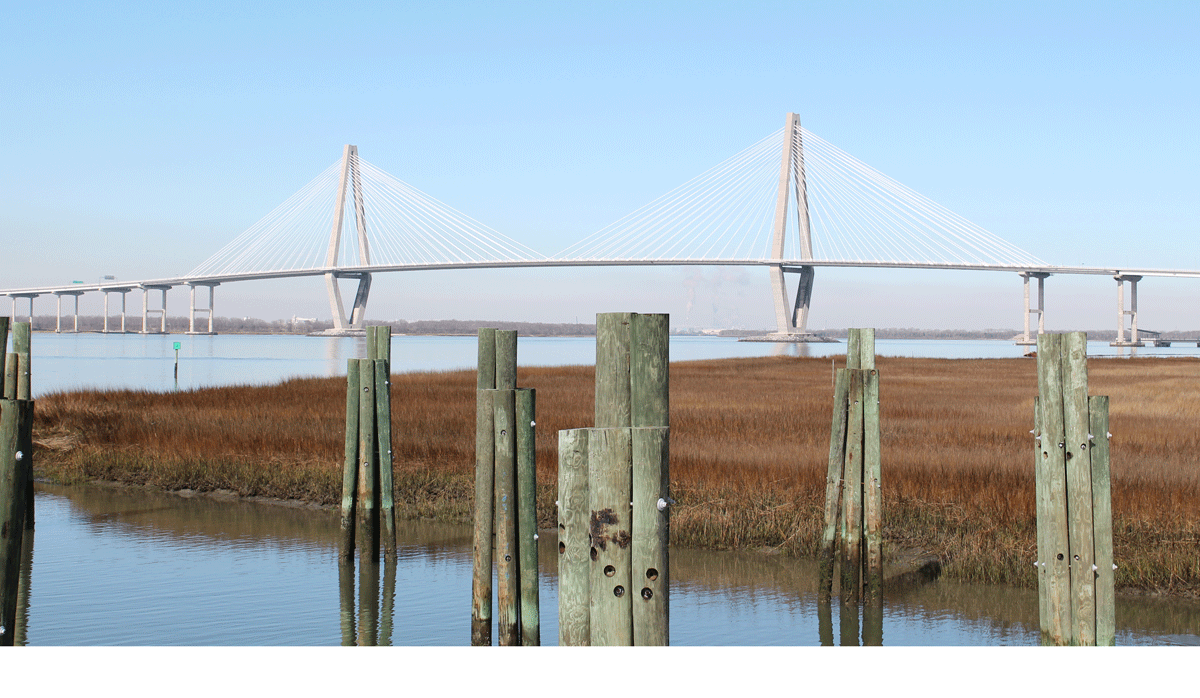
Ravenel Bridge

Beautiful, but quite useless in a snowstorm, Ravenel Bridge

It wasn’t much by Virginia standards, but it was enough to shut down the city. Even the elegant Ravenel Bridge, the main route to the downtown area, was closed throughout most of our visit. It was opened briefly when temperatures warmed, but quickly closed again when ice falling from the rigging began crashing onto crossing vehicles, apparently annoying drivers in them.

Because we were staying at Mount Pleasant, this meant either taking the alternate route with hundreds of cranky re-routed commuters or staying on the island and seeing the sights there.Initially, I was quite disappointed. I wanted to experience the Charleston I’d been hearing about for so many years, its lovely markets and restaurants, and that legendary Southern charm.

We instead went out to Isle of Palms, and explored Fort Moultrie on Sullivan’s Island. It was all quite nice, but cold, and I’d hardly say charming.

Then we met Mazie Brown, a sweetgrass basket weaver with a small stand on Highway 17. Sweetgrass weaving, South Carolina’s official handcraft, is an art only found in this region, and the baskets are sold only in the downtown markets and along this highway. Mazie was one of only a few weavers brave enough to set up shop that day, when cold was warding off potential customers.

From the moment we entered her tiny hut we were charmed. Mazie flashed us a wide and welcoming grin, and commenced to chatting as if we were old friends.

“You’re lucky you come by when you did,” she said. “Soon the only place you’ll see baskets like this is in the museums.”

Mazie talked about her art, which she’d been practicing since she was 6, and this stand, which her Mama had established 29 years ago and which Mazie had taken over after retiring from her nursing career. While I listened, I pulled down some of her creations, running my fingers along the intricate patterns woven from grasses and palms.

“Those dark parts is pine and bullrush,” she said, pride emanating from her deep brown eyes. “And that’s palmetto, holdin’ it all together.”

Her weathered hands stayed busy, braiding a stalk of sweetgrass into a circle, the way her Mama had taught her: in the Gullah tradition maintained more than 300 years by Africans brought to America in slavery.

“It’s dyin’ though,” she said. “My children want nothin’ to do with it. They don’t have the patience…rather play on their textin’ machines.”

My husband held up a serving platter that she said took about two and a half days of weaving to complete. What a shame this art might disappear. We’ve since learned that not only is the coming generation losing interest, but regional development is depleting the sweetgrass supply. Access to the grasslands is limited; harvesters travel nearly 90 miles to find grass, or they buy it like Mazie does.

“When I was a girl, I used to go with my Daddy to pull it up,” she said. “Wouldn’t do that today. There’s so many snakes in the grasses now.”

We purchased the platter and asked her to sign the back. Her face lit up afresh and she pulled a sharpie of her pocket; our request wasn’t original.

“Some folks don’t want ‘em signed, but I’m always happy to do it,” she said.

As she carefully spelled out her name on the evenly spaced palmetto coils, Mazie continued to talk about her family, being alone despite two marriages, surviving cancer seven years now, and about her love for the weaving craft. We could have listened for hours; she had such a sweet storytelling gift.

Mazie Brown

Mazie Brown, artist and storyteller, Charleston personified

So enchanted was I by Miss Mazie, I did something I rarely do, as anyone who knows me will attest. I wanted to have my picture taken with her. I could tell when I asked that she shared my loathing for the camera, but she obliged (albeit, never looking into the lens). Jerry and I both felt compelled to hug her goodbye.

We eventually got to the city, to a few good restaurants (shout out to Page’s Okra Grill!) and to the market where baskets similar to Maize’s were triple the price and stalls were just business establishments. After Mazie, it was a bit anticlimactic.

I’m not sure we would have met Maize if not for the weather; I’m so glad we did. To me, she is now family. To me, she is Charleston. And a lovely, charming place it is.

I yam where I swam

12 Aug

I’ve taken on too much. Again.

It’s a regular thing for me.

A wife, a mother, a friend, a writer, a housekeeper, a supervisor, a wreck.

plates for spinning

How many plates can you spin?

Does my story sound familiar to you? I race everywhere, arrive five minutes late, and spend my time there thinking about where I’m heading next. I have a bag that is brimming with receipts, notes, and forms I accumulated this week that I keep promising myself I’ll sort as soon as I get a free minute. And, as you’ve no doubt noticed, my weekly blog post is two days late. My life has become a circus plate-spinning act. How hectic does life have to get before I start saying no?

So naturally, when the opportunity to learn Hebrew in a free, fast-paced, fire-hose of a daily commitment arose, I jumped at it. Feet first; no floaties.

That’s why today I’m wallowing in a pool of self pity, trying to remember that what sounds like “he” is the Hebrew word for “she” and what sounds like “who” is really “he.”

Me is who.

Dog is Fish.

And a yam is something we swim in.

Whose idea was this? Yes, of course. It was mine.

As such, I come to that all-too familiar scene, again, wherein I must create a list of obligations and responsibilities. Then I scrutinize, categorize, and prioritize the list, asking about each item, “Is THIS the most important thing?”

It’s a rather long list, but when finally sorted and cut back to the priorities, it looks, oh, so familiar: God, then family, then writing. Well, sometimes it’s writing and then family, but don’t let that out, ok?

Out of the blue, I’m reminded of a story I wrote a few months ago about this very topic, intending to post it on my Portrait Page, but instead I lost it in the yam of business that is my life (NOTE: that’s not irony; it’s a pathetic coincidence).

So today the story goes on my page, as a promise to myself that I will start again, focus on what’s important, and, if need be, do the same thing next week.

Its actual title is My Main Event, but perhaps I should post it as “Portrait of a Woman Who does too much.”

I won’t ask you to go read it today. (NOTE: that wouldn’t be irony; it would be pathetic hypocrisy). But, when you get some free time, or when you want to learn the secret to prioritizing, it’ll be there, waiting for you.

Shalom.