Ban Book Banning: Read with Your Brain Turned On

24 Sep

I’m blogging early this week because I have some busy days ahead, but I didn’t want Banned Book Week to go by without mentioning it.

You would think that as a Christian writer, I’d be all for banning books—particularly those that are “bad” for us and our children.

Well, you’d be wrong.

I’m against reading many of the books that are popular in our culture, but I can’t support forbidding them.

Book banning is usually the result of a person or group of people who decide what they think is best for everyone and who exert great energy to turn their personal views into an edict. The problem is, there are as many different viewpoints as there are people, and theoretically, if everyone were allowed to strike those books they thought “bad” because they contain profanity, opposing politics, violence, racism, religious references, or (name your offense here), there would be little quality literature left on the shelves. For example, one of my favorite books, Charlie and the Chocolate Factory, by Roald Dahl was once placed in a Colorado school’s locked reference collection because a librarian thought the book embraced a “poor philosophy of life.”

Think that’s ridiculous? Well, in 2010, a school district in Riverside California even banned Webster’s Dictionary because it contained sexual content. Now, truth be told, I’m still smarting because the Webster gurus recently made “nother” a word (as in, that’s a whole nother issue), but I’m not going to swear off dictionaries because of it.

I do, however, highly endorse employing a bit of discernment when choosing books, particularly with regard to stocking school libraries. Middle schoolers do not need access to sexually explicit materials, and high schoolers do not need access to bomb-making instruction manuals, and NO SCHOOL needs to stock Fifty Shades of Grey. There are so many good books in the world, librarians should have no trouble accumulating age-appropriate literature for their shelves.

I also firmly believe in knowing what my children are reading and being available to discuss their books with them. I learned the hard way. When my oldest was a teenager, I eagerly fed his desire for Goosebumps books because I was just thrilled that he wanted to read. I never read any of them. A few years later, he saw me sorting through books to keep for his younger brother and urged me to throw them out. He said they were awful—kids died in nearly every book, and they were depressing.

In shock, I asked why he’d read them all then. He shrugged and said, “They were addicting.”

So now, I attempt to read every book my youngest reads—a feat that is becoming more difficult now that he’s in high school, but it has paid off. Last year, his freshman English class was assigned Flowers for Algernon, by Daniel Keyes. It is a terrific story told from the viewpoint of a mentally feeble young man, but it contains three of what I believe are inappropriate scenes for a teenage boy. I was so glad I read them first. I marked the pages and told my son of my concerns but said he could read them if he really wanted to. He chose not to, so I filled in with a PG-rated description of the events and he was still able to pass all related quizzes and even write a good essay. Frankly, I would have been greatly disappointed if he’d wanted to read it, so I was quite proud at his decision. And I am greatly disappointed in his teacher for not finding something better suited out of all the good literature available. However, I think that if I’d outright forbidden him to read it, he would only have been more inclined to see what all the fuss was about.

The following books have been banned (or are still banned) in some schools:

Books from the banned list

Contraband…I may be in deep trouble.

To Kill A Mockingbird, by Harper Lee

I Know Why the Caged Bird Sings, by Maya Angelou

Snow Falling on Cedars, by David Guterson

Brave New World, by Aldous Huxley

The Kite Runner, by Khaled Hosseini

The Things They Carried, by Tim O’Brien

The Lovely Bones, by Alice Sebold

The Adventures of Huckleberry Finn, by Mark Twain

Diary of Anne Frank, by Anne Frank

Harry Potter (series), by J.K. Rowling

James and the Giant Peach, by Roald Dahl

A Wrinkle in Time, by Madeline L’Engle

Fahrenheit 451, by Ray Bradbury

If the irony of that last one doesn’t make your heart hurt, you need to add it to your reading list.

The banned book list is much longer, but these are books I’ve read, loved, learned from. They entertain, educate, and often give insight into other people’s trials and tragedies, and their triumphs. Many I would not recommend to my youngest—yet, but others we’ve already shared. I can still remember reading To Kill a Mockingbird when I was a teenager. I couldn’t fathom racism because I lived in a nearly all white community in Rhode Island, but I was able to recognize it for what it was when I joined the military and saw how some people treated others, and I believe it made me a bit more empathetic than I might have been. How could someone ban that book? I’ll never understand.

Why am I so adamant about banning book banning? Well, just this week I learned that a California school is tossing out all Christian themed books and books by Christian authors. The school superintendent who mandated the removal said the school would  “not allow sectarian materials on our state-authorized lending shelves.”

Included in that list of literature that is now denied to their students would be Holocaust survivor, Corrie Ten Boom’s The Hiding Place, C.S. Lewis’ Narnia series, and technically, I guess, Tolkein’s Lord of the Rings series as well. How about the writings of Rev Martin Luther King Jr? Was he not a Christian? What a dangerous, slippery slope we’re on if this is allowed to continue.

The upside of this recent insanity, for me anyway, is that although my book in progress would be banned at this school without even being read, it would put me on a list with C.S. Lewis, Tolkein, and Corrie Ten Boom—I cannot imagine a greater honor!


(Note for busy parents: If you cannot keep up with your child’s reading, there are apps and websites that will check books for appropriateness and even tell you about specific words or scenes to expect and their context. I recommend Plugged In, at http://www.pluggedin.com)

 

Writing Tips about Readers: One is Enough to Get You Started

19 Sep
Stephen King's On Writing

Good place to start a writing journey

Today’s blog is inspired by Stephen King, and an unknown reader.

I’ve just finished reading a book that I recommend to anyone who writes or wants to, whether for a living or just for the simple pleasure of putting words on the page.

It’s Stephen King’s On Writing; A Memoir of the Craft.

Author’s Note: Let me make it clear here, I tend to avoid Stephen King books because I have an imagination that cannot relinquish images once they flash before my mind’s eye. (The Green Mile’s John Coffey is as real to me as any person I’ve ever met; he scares me, and he’s one of the good guys.)  However, I appreciate good writing and admire King’s work because he can create those vivid images, and in a way that seems effortless. In fact, if he weren’t such a phenomenal writer, I wouldn’t have to avoid his work—how’s that for a back-handed compliment?

But this book is different. It’s a beautiful depiction of writing as a passion that, once it grabs you, simply must be acknowledged and satisfied. King’s memoir weaves stories of his personal journey with bits of advice and encouragement to writers and examples of beautiful prose in a way that would have inspired me to quit my day job if I hadn’t already. He makes me appreciate anew the joy of writing for writing’s sake.

And as a bonus, from the pages of King’s beautifully written narrative, I’ve picked up two valuable bits of advice that I’m incorporating into my life right away.

The first is that to write, one must read. If Stephen King says so, it must be so.

All I can say is, YAY!

(If there were a way to make that look happier without one of those flashy neon “marching ants” borders, I’d do it; it’s just that cool. But for now, “Yay!” will have to suffice).

So, in the Portrait Writer’s world, reading is now a sanctioned, necessary part of the job. That’s like sending a kid to a candy shop for time out. To all of you back at the office who are still suffering through those annual training classes on filling out travel claims and understanding the importance of submitting form 3C with your timecard request to adjust for an unanticipated increase in traffic volume on I95, I can only say…

“Boo-ya! I’m studying Barbara Kingsolver!”

Of course, I will share my reading adventures and recommendations along the way, so you can skip right to the good stuff on your own reading list. (Life’s too short to waste time reading bad books.)

The second concept I’m adopting is to write to an ideal audience, and this epiphany couldn’t have come at a better time. I’ve learned over the past few weeks that not everyone likes everything I write (gasp!) and, if I took to heart all the advice I’ve received lately, my next blog would be a politically correct, non-offending piece of drivel. I’m grateful for every person who reads my blog, and I appreciate your feedback, particularly because it helps me see some things from different perspectives, but it won’t change my writing. In fact, I suspect that when I hit a nerve, it’s not the words that cause you to wince.

King suggests writers choose one person that they respect and know well, and write only to that person. And so I have identified my ideal reader as a young man we’ll call Fred. He’s well educated and knows who God is, but has never really read God’s love letter to mankind. He’s angry at this entity we call God and, as a matter of fact, is gathering evidence to support his claim that if God does exist, He can’t possibly care for us very much. I cannot convince Fred otherwise, but I can show him over time why I believe differently.

And by the way, Fred thinks I’m hilarious. That’s why every once in a while I have to write something silly, just to make him laugh.

Fred, I promise you that if you keep reading, I will keep writing. I wish I could promise more, but the rest is not up to me. I’m a Proverbs 16:9 girl; I’m not sure where this train is heading, but I’m glad to be along for the ride.


In his heart a man plans his course, but the Lord determines his steps.” Pr 16:9


What’s Green and Hurts All Over?

6 Sep

Kudzu.

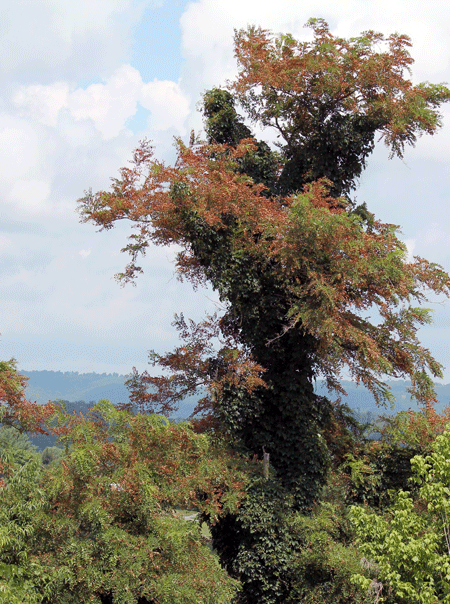
I never really gave it much thought, but over the summer, as I drove through Virginia’s southern counties, its pervasiveness intrigued me. I did some research and now I find the plant fascinating, or at least, its story. It’s a story of compromise.

Kudzu came to America in the 1800s the way sin enters one’s life—as a beautiful and desirable object from a distant land we’d heard of, but never seen. Let’s not call kudzu alien or unnatural to the region…that sounds so unrefined; how about exotic? What a delightfully mysterious word, exotic.

All the nicest gardens just had to have Japanese kudzu, that hearty and lush vine-bush that grew quickly and provided wonderful shade. Of course, like all exotic possessions, it came at a steep price, but with a little reshuffling of funds (perhaps we could use that money set aside for charity this month…?) status quo was obtained.

During the depression era, someone discovered that kudzu could stop soil erosion. The government began pressuring southern farmers to take it out of their pots and gardens and plant it around their fields and along highways; they pressured the way young men pressure young women to do things they ought not. In some cases, the government even paid farmers to defile their soil. And the farmers agreed, because, well, everyone was doing it. And besides, it wasn’t exactly unpleasant.

Soon, the farmers realized they’d made a mistake, and that new life was being created at rapid rates. The government said, “Wow, that’s quite a mess you’ve gotten yourself into,” and turned away. They went back to Washington, removed it from their list of species acceptable for use under the Agricultural Conservation Program, and labeled it a weed.

Kudzu planted its roots deep into the Georgia and South Carolina soil, strengthening into a network of obstinate toddler-like tendrils that shot up and raced across the ground, stopping to climb mailboxes and telephone poles. It was cute at the beginning, like a child’s first swear words, or those “But I wanted a trophy!” temper tantrums that we’d video tape, chuckling. Coddling fools, we lifted some of the barriers so they wouldn’t feel stifled—anything to keep the little ones happy. Next thing we knew, the vine children became rebellious teenagers, racing over and past farmland boundaries, pushing down fences, climbing over walls of absolute truth that blocked their paths, and yelling, “Progress through freedom!”

Winding its way up and around. Isn't it pretty?

Winding its way up and around. Isn’t it pretty?

Throughout the late 1900s, the vines thrived through a system of situational ethics supported by the motto, “anything goes if it benefits me.” They started climbing trees, wrapping their manipulative tendrils around even the tallest and heartiest species.

Townspeople noticed, but did nothing.

“The leaves make a pretty contrast against the forest, and it isn’t hurting anyone,” they’d say to protesters. “Stop being so dramatic and show some tolerance, for Pete’s sake.”

Others said, “Sheesh! It’s not as bad as cogon grass or privet, so what’s all the fuss over a few weeds?”

The trees noticed though, because they’d become embroiled in a battle over light and nutrients, and the war was very real to them.

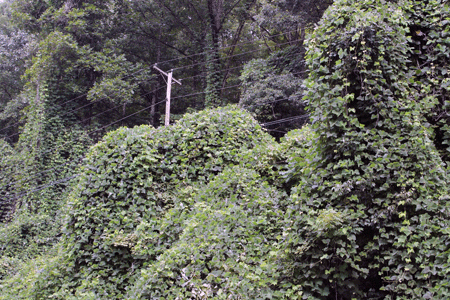
Kudzu devouring a hillside

It’s not really hurting anything…

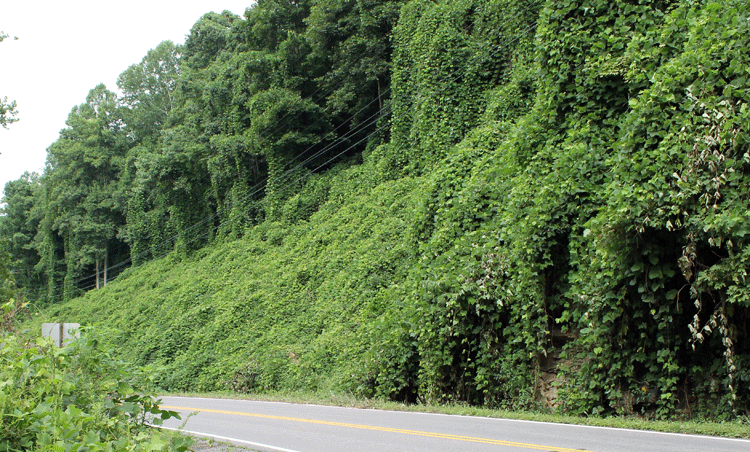
Sadly, their age and wisdom were no match for agility and avarice, and millions of acres from Florida to North Carolina (and now Virginia) and as far west as Texas were smothered and choked. Kudzu and other weeds like it now consume an estimated 150,000 acres of trees and other flora each year. Under every one of those delightful green towers (look Dad, that one is shaped like a clown!) is a dead or dying tree that once contributed greatly to our ecosystem.

In 1998 it was listed by the U.S. Congress as a Federal Noxious Weed, but this fancy label didn’t come with an eradication plan. Besides, some people enjoyed it. They fed it to their animals, made baskets, and chopped it up to use as fertilizer.

“I’ve got it under control in my back yard; I’m not too worried about your problems.”

In Japan, it’s made into jelly, so we may as well make room on the store shelves now. It’s coming, whether you like it or not. If you don’t, you’re a hater.

Can it be defeated? Possibly. People once tried to introduce an insect that supposedly eats the kudzu vine. Regrettably, it also devoured soybean crops. They’ve tried locating the root crown, which can be quite deep, and destroying it, but some reports say even the tiniest sliver of surviving crown can regenerate. Many eradication methods could work, but it will require a strong stand against compromise and a lot of effort. Too much effort it seems, now that the beast has been allowed to run wild for so long. In some regions entire houses, barns, and silos have been overrun, as if it were easier to leave than fight. Perhaps the owners just didn’t want to be seen as bullies.

Yes, it’s bleak out there, but what do you think? Is the battle lost?

kudzu overwhelming roadside

Kudzu, or muscadine, or porcelain berry, or Virginia creeper. I’m not a botanist and can’t swear, but the vines are all similar, and inflicting similar damage.

“Then desire when it has conceived gives birth to sin, and sin when it is fully grown brings forth death.”  — James 1:15


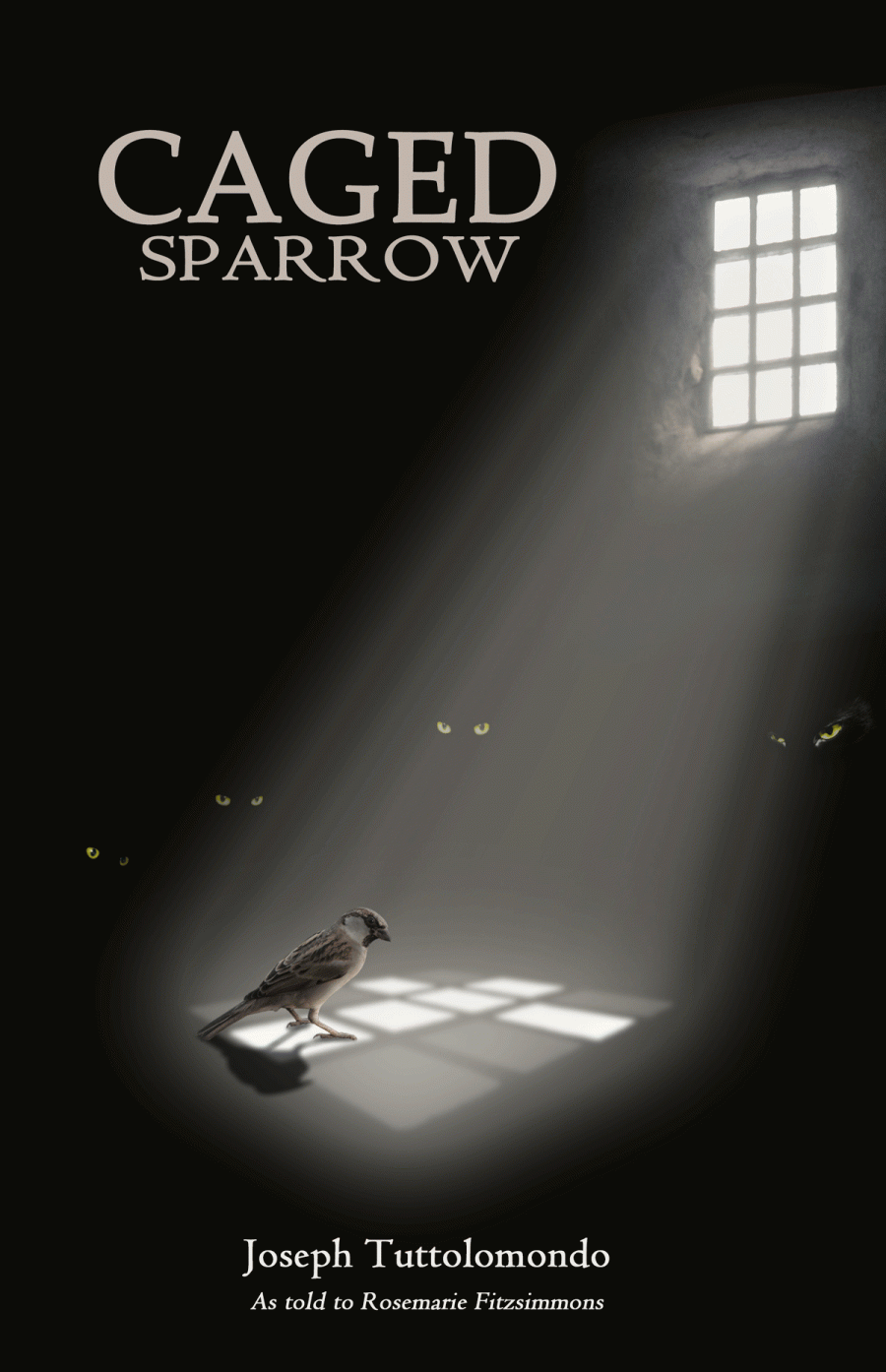
Love Tosses Caged Sparrow Over Another Hurdle

27 Aug

I honestly believe it will never be this special again.

First, some great news…We have an agent! Her name is Diana; she read my proposal for Joe’s story and asked for the manuscript Friday. Over the weekend I went through it one last time and pronounced it finished Sunday night. I sent a hard copy to Joe and electrons to Diana; she is now working on finding the right publisher. I couldn’t say for sure whether Joe or I was more excited, but as I listened to Joe’s elation over the phone Friday, I was tickled to pieces to have witnessed it. (I do believe he did a little jig.)

Completed manuscript

One step closer to the book rack!

It was a sobering moment, Sunday night when I hit the “send” button, and with one click, transmitted more than a year’s worth of work and dreams off to an unknown world in cyberspace. I sat there staring at the “message sent” notice for a long time, contemplating the true scope of this journey, which actually began in the early 70s, sitting with my Nana in her giant four-poster bed, listening to her read from Laura Ingalls Wilder’s Little House in the Big Woods. I became so inspired by Laura’s storytelling gift that I knew, just knew, it was what I wanted to do for my life. I started writing with abandon, and when my English teacher, Mr. DeRobbio, said I had a gift, I positively soared. I was going to be a writer!

But I didn’t do it. Not really. I stifled the call to write, with a military career (during which I wrote as a journalist, but not for myself–yet even there I received encouragement from people I admired and still try to emulate, like Pat Gibbons, Tom Bartlett, and Ken Smith-Christmas…), and I put it aside for two wonderful children and years of busyness. All the while, I knew God was nudging me…“So, when are you going to start?”

Then He put friends in my life to nurture and encourage, each one sending me a little closer to the ledge—Susannah Johnson’s “The Artist’s Way” class pushed me to Sarah’s writing group, where she, Martha, Meredith, and Anne dared me to dream about “what if?”

One domino toppled the next. I found myself at a writers’ conference that fanned the spark into flame, and met inspiring people like Beth Pensinger and Erin Elizabeth Austin. Over the next year I was a fly on the FB wall, watching their struggles as Beth wrote and published a sweet read called, “Let Me Fall: The Love Story Between God and His Dimwitted Daughter,” and Erin inspired thousands by sharing her battles and victories over darkness and founded Broken but Priceless Ministries. I’ll never be able to express to these women how integral they’ve been in my journey, and yet we barely spoke to each other.

But I STILL didn’t listen, so God forced my hand. He sent Linda Rondeau, a fellow writer and perfect stranger. She just appeared outta’ nowhere, armed with a story about a man who went to prison for a crime he did not commit and looking for someone who might want to write it. Another domino. This led to Joe and his awesome story.

Desire, ability, a story that absolutely HAD to be told–I had no more excuses. I even had my husband’s wide-eyed, “I’m-a-bit-nervous-but-I-know-this-is-important-to-you” blessing, and two sons who were glad to see me doing what I loved. And then sweet, sweet Phanalphie, of RhueStill Inc., who didn’t even know me yet but read my writing and offered me a net to jump into, and she probably would have flown out here from Oklahoma and pushed me off if I’d asked her to.

And again, I didn’t leap off the cliff. I more or less attempted to inch my way over the rim, scraping my knees as I fumbled blindly for toeholds, and I found myself only a couple of feet down, clinging to a ledge by my fingernails, half in and half out of two vastly different worlds. It took more nudging, by many more friends. Carrie and Kevin, my best friends and confidantes from work, helped pry my fingers off the ledge by assuring me that “the gang” would be fine, and although they’d miss me, I had to leave or risk going through life not knowing. Since I left, both of them have sent me inspiring notes when I really needed them, and many others from work continue to check in. Chuck and Rebecca check in almost daily, and let me whine on their e-shoulders when things don’t quite work out the way I want them to.

I also received tremendous support from my prayer partners, Kathy, Dino, Linda, Chris, and Michele, from my neighbor Julie, and friends and family from all over like George, Heidi, Jo, and Willa.

And a book was born.

While I was writing this I thought, you probably wouldn’t want to read a bunch of names of people you don’t know, but then I realized, this isn’t about the names. You do know these people. They’re in your lives as well. You just call them something different.

The bottom line is, if there’s ANYTHING you want to do, you can do it, but not on your own. Dare to dream. Then surround yourself with positive, prayerful people, and listen to God’s nudging; remember that He put this desire in your heart in the first place.

I will write more books. Joe’s story is powerful, but it probably won’t make either of us famous. I will write better books, and more than likely a few flops. I may even receive recognition for some, although that is not my measurement of success.

But it will never be like this. This is special. This is the end of the beginning. And you helped.

Thank you.

Lost in Dr. Who-ville: A Whole Lotta’ Baking Going On

22 Aug

There’s a stranger in my kitchen, baking cookies.

He looks a lot like my teenager, although he’s a foot taller than last year’s model.

But he’s baking cookies. For the second time this week.

There’s flour on the fridge, on the window ledge, and on the sink. There’s even some in the mixing bowl.

I wouldn’t say he can’t bake. He just doesn’t. Last Christmas the two of us made gingerbread together and I thought he was getting the hang of it. I didn’t notice until too late that he’d added a tablespoon of whole cloves instead of ground.

Mmmmmmm, crunchy…

(Before you judge him on his lack of culinary knowledge, you should know that when his mother was a teenager, she foraged through the pantry for a snack and came up with a pretty, gold-wrapped square of something called “bouillon” and popped it into her mouth. He comes by it honestly.)

Flour on the table

Now that I’ve regenerated…boy, am I hungry!

There’s flour on the stove top. He hasn’t even pre-heated the oven yet!

I guess what I’m trying to say is, of all the amazing things this talented young man enjoys and does well, baking is not a strength. Cooking, yes. He can produce a mean Chèvre/Gouda mac’n cheese with very little effort, or a satisfying one-pot meal in a Dutch oven over a campfire. But these are forgiving dishes; they can handle a little miss-handling, if you know what I mean.

Baking, however, is a calm task that requires precise measuring and very little bobbing. Those of you with teens know bouncing and sudden, unexplainable leaping comes with the territory. Unless there’s work to be done, in which case they’ve got that whole comatose thing mastered.

There’s flour on the cat.

So, why would an otherwise normal teenager be using up perfectly good summer vacation days to do something other than Skype and Minecraft?

Well apparently, tomorrow is the 912th-or-something season premiere of Dr. Who. You remember Dr. Who, right? That British program(me) about a delightfully cocky extraterrestrial who travels everywhere and everywhen for no apparent reason and always manages to arrive just in time to prevent the demise of the universe.

Frankly, I didn’t even know the show was still in production, but that gives you an idea of how far I’ve fallen behind the times—although in this case, does it really matter? (Ha! Timelord humor.)

And also, apparently, this season premiere thing is a big deal. The kind of big deal that calls for a Superbowl-type party, at which chips and dip are considered unacceptable fare, as are bacon, baked beans, and bread & butter. So, looking at the list of acceptable fare, and seeing that Fish Fingers with Custard was already taken, and TARDIS Pies (the flavor is bigger on the inside) contain some rather costly ingredients, he opted to make cookies. Big, perfectly round cookies that must be decorated with Circular Gallifreyan writing. (I refuse to look that up, on the grounds that I might learn that it is, indeed, an accepted language with its own dictionary, thesaurus, and syntax rules).

Yesterday he made a half-batch, as a test. They were quite good, and floury. That afternoon we had an appointment across town, after which we stopped for lunch.

The meal is on me, I told him, but anything extra comes out of your own money. He pulled out his wallet to check his finances and when he opened it, up wafted a puff of white flour.

“Hmm,” he said, grinning as he watched the powdery white dust settle on the car seat, the dash, and all over his lap. “How’d that get in there?”

I could only watch, incredulous, and laugh with him.

Yep, I thought. I’m pretty sure that’s my boy.


 “That’s monstrous! Vaporisation without representation is against the constitution!”      — The Doctor

For Bill, Who Knew the Secret

9 Aug

Yesterday was the final day of a long goodbye to our friend and neighbor, Mr Bill. We sent him off with military honors and with much wisecracking and laughter, as was befitting a man voted class clown in high school and who laughed habitually, with great abandon.

Mr. Bill’s life, though too short, was a life well-lived. He was one of those rare people who truly knew that the secret to happiness is to love God and love others. His sweet wife Julie says often of him that he never knew a stranger, which aptly describes the way he so easily drew everyone in, and how effortlessly he could make anyone laugh. His gregarious joy was so contagious that even people who’d only met him once or twice came to the funeral yesterday with stories of his antics and his generosity. A woman he worked with as a teenager at a Hallmark store in the 70s wrote from Arizona to tell of how fondly she still looked back on those days, and how, after she shared her regret with Bill that she’d never received an Easy-bake Oven when she was a child, he’d left one on her car one day, gift wrapped. She still has it today. Another man, who knew Bill in the early 80s and who hasn’t seen him since, came all the way from London to say goodbye, because the bond they’d formed all those years ago had been just that strong.

William Dean Turner

William Dean Turner

He joked about everything, even his cancer. He wrote in a letter to his friends: “I had a PET Scan, which is like a CAT Scan, only it’s for people who have dogs, fish, birds, or are just not cat fans. This scan showed the tumor had shrunk to half its original size. Everyone who was not mentioned in my will was overjoyed.

Later, when the news came that the cancer had resumed its growth and the doctor told him he might have 4 months or 40 years, he said, “that’s the same thing my parole officer told me!”

We met Bill about 10 years ago, through our son, who was around 5 at the time, and who is the reason we call our neighbor “Mr. Bill.” That title made us giggle (my husband and I, that is, because we’re children of the 70’s Saturday Night Live).

Our son developed a Dennis-the-Menace/Mr. Wilson-type of relationship with Mr. Bill. I swear they started swapping jokes almost from day one. Some days our son would stand draped over our mailbox, watching for him to come home from work, bursting at the seams with the “gem” of the day. Seeing his car come around the corner was an occasion for great glee. Bill would leap from the car and fire off a gem of his own that he’d been saving for just that moment. I suspect each of them poured through the joke books every night, looking for ammunition.

Bill was good to all children, and children loved him. He had a child’s heart.

Throughout his Chemo treatments, Bill continued to celebrate life, especially last Halloween (his favorite holiday) when, despite being weak and tired, he dug through the garage and hauled out the house-sized, inflatable black cat with a motion-sensor caterwaul-screeching device and erected it across his walkway (because the kids expect it, he said).

After he passed away last Saturday, my family was saying a prayer of thanks for Bill and his friendship, and it was my son who hit the crux of what had been Bill’s mission on earth, when he said, “Mr. Bill truly knew how to love thy neighbor.”

As I stood with friends and at Quantico National Cemetery watching the Air Force honor guard fold the flag and handed it with great reverence to Mrs. Julie, I realized we’d soon be forming a line to walk past his coffin, and I’d have one final moment, just between the two of us, to say something noble. I actually fretted about this, because it suddenly mattered to me a great deal, but when my turn came, I had nothing. So, I just patted the coffin, closed my eyes, and that’s when the words came:”

“Goodbye Bill, and have fun up there!”

And I know he will.

When All You Want is Just Out of Reach

7 Jul

I’m up early and ready to work. The boys are away, the house is quiet, and the kingdom is mine! It’s such a lovely morning and the office is too stuffy. I figure a little change of scenery might be productive.

The couch in the living room would be a perfect place to work today. Cozy and quiet. I could even open the windows and enjoy a little bird-house symphony while I work.

So I pile my notes together, a couple of reference books, my laptop, its cord, the mouse and pad, and a bag of pumpkin seeds (brain food). I maneuver the stairs with my towering encumbrance like a tightrope walker, poking tentatively ahead of each step with my toe in search of the cat. I can’t see him but I know he’s there, trying to guide me by stepping wherever my next foot is about to land. For once, I don’t trip on him. It’s going to be a great day.

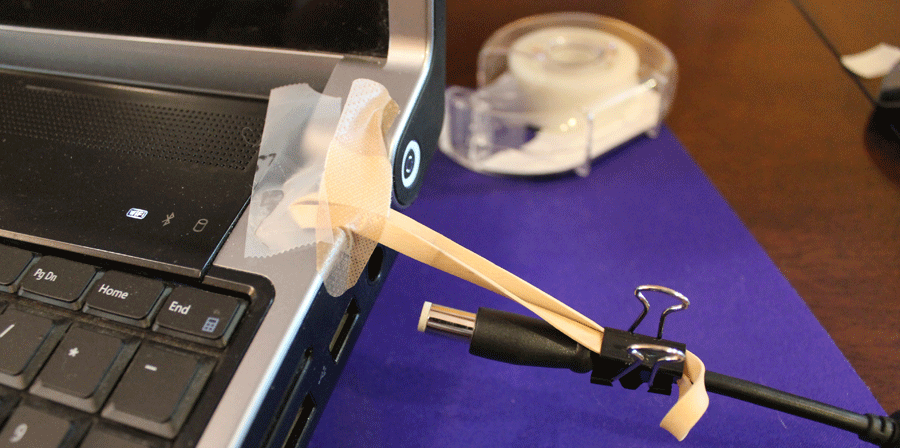
There are three available outlets around the couch. I set all my equipment on the coffee table and plug in to the outlet across the room, but it’s an uneasy arrangement. The cord is two feet off the ground and stretched taut like a limbo bar. The battery weight keeps pulling the power adapter from the computer jack, so I pull a kitchen chair around and set the battery on that. It helps, but not much. Every time I move the plug leaps out. Anyone watching me type would have thought I was wearing an imaginary straight jacket; I’m afraid to even turn my head for fear of upsetting the air molecules around me. Despite my efforts, the cord will not stay attached. I have to try a different outlet.

Not quite close enough

Just. One. More. Inch!

I plug into the outlet behind me, which requires moving all my gear to the other side of the couch to make it work. Do you prefer one side over another? I do, so it feels alien to sit here, but I make it work. Once again the cord is stretched precariously, only a few inches off the ground but this time across the entrance to the kitchen. Now that seems a bit safer, until I go to the kitchen for coffee and trip over it. Twice in the same minute. Going and returning. Both times I yank out the cord. You’d think I’d remember and not do it a third time. You don’t know me well.

Clearly, using this outlet is going to kill me, so I switch to the third outlet, which is at the other end of the couch. The cord runs safely parallel to the couch, and…almost reaches. I switch sides again, but still come up about two inches short. I bridge the gap by balancing the computer on the couch arm, which is round. By setting the mouse and pad on my knee and planting my left wrist on the edge of the keyboard as an anchor, I achieve pseudo victory. It’s an awkward position, not taught in typing class. Anyone watching would have wondered if the imaginary straight jacket might be on upside-down and backward, perhaps with one leg stuck an armhole. I manage to type and teeter my way through an entire sentence before dropping the mouse. When I lean over to retrieve it, I nearly let go of the computer.

This is ridiculous, I think. I should just go back upstairs where I belong. I stare at the outlets with pouty eyes. And stare at the outlets. And stare at the outlets.

Sometimes we stare so long we can’t see anything else but the problem. Munching pumpkin seeds brings no enlightenment; so much for brain food.

Resignedly, I start to gather my things, but I’m not about to push my luck with the cat on the stairs. I’ll sit at the kitchen table. Not as cozy, but safer anyway.

One last disdainful look back at the cozy couch stops me in my tracks. Anyone watching me would have wondered if perhaps I need a real straight jacket, as giggles overtake me.

Move. The. Couch.

Five minutes later I’m joyfully ensconced on the couch in the center of the room, typing away today’s epiphany: Sometimes you have to stop looking at the problem to find the solution.

It’s going to be a great day.

Christian Prayers for a Muslim Tradition

28 Jun

Today is the first day of Ramadan, which has always meant nothing to me because I understand very little of the Muslim religion and its customs.

However, this year I find myself thinking of Fatima, a beautiful woman from Pakistan who watched my youngest child for more than five years, and I’m picturing her in prayer during this time.

Fatima had a quiet spirit, laughing eyes, and an accent that made everything sound exotic. We loved the way she pronounced our son’s name—not “Charles,” but “Shar-less.” Fatima and her family moved away when my son entered the first grade, but the peace and grace about her stays with us to this day.

Flag of Pakistan

Flag of Pakistan

We knew she was Muslim, but we were indifferent about it. She dressed in the conservative shalwar kamez (pants with an ankle-length, stylish shirt), and a scarf that I believe is called a hijab. If I’d taken a moment to ask, she would have happily told me what it was, but I showed no interest in her customs. When she asked for certain days off during Ramadan, I found alternative care, but did not inquire about that either. I guess I didn’t want to pry, or have to “defend” my own religion. I wish now that I had asked.

Fatima loved America. She studied for weeks before her citizenship test, and I can still recall how her face lit up the day she told me she was now a U.S. citizen. She celebrated Independence Day, Flag Day, and Memorial Day. She asked me questions about my uniform, and loved the idea that I was a Marine. On September 11, 2001, she grieved with the rest of America when our nation was attacked.

That was the first time I asked her anything about her religion, and I’m ashamed to say it was more accusatory than curious. I rushed home early from work that day and went straight to my son, practically snatching him from her hands.

I looked into her eyes, which were not laughing that day, and I demanded to know, “What kind of God do you have that he would endorse something like this?”

She practically sobbed her response.

“That is not our God. Our religion doesn’t teach this.”

It was somewhat of an epiphany to consider that perhaps those who profess to follow Allah are as varied in character as those who profess to follow Jesus. Some are good, some are evil.

I also knew Fatima loved my son. She practically raised him, while I went off to work, alongside her own two children. She read to them all together, bought his favorite foods, taught him the Arabic alphabet, and gave him gifts at every occasion. Even Christmas. She loved Christmas, and I never thought to ask why.

So that brings me back to Ramadan, and why it matters to me now. I’ve learned a little bit about Muslims since those days. I worked for a while in a place where terrorist group activities were tracked and analyzed. There I read, almost daily, stories about Boko Haram spreading its anti-Christian violence across Nigeria, and the fear and hatred being spewed throughout Indonesia by Jemaah Islamiah, and now the atrocities spilling out of Syria and across Iraq with mind-numbing speed, all in the name of “Allah.”

I believe more Muslims are like Fatima than Saddam Hussein, and because I believe that, I’d say they’re a lot like me. They want to please God, and follow His will for their lives. So for the next month, as the world’s Muslims enter a time of prayer and fasting, I will be praying as well. I suspect we’ll be praying for the same things:

1. They will be praying to become spiritually stronger. I will pray that as they seek to know God, He will reveal Himself to them, during prayer time and as they dream at night, as a loving God and a God of mercy.

2. They will be praying in appreciation for God’s gifts. I will pray that as they search for the Truth, they will learn it. While they study their most precious gift, the Koran, let them find and take to heart its command to read the Injeel (the New Testament), and realize that if God is, indeed, all powerful, He can surely maintain the integrity of a little ol’ book over a mere 2,000 years.

3. They will be praying to become more obedient. I will pray that their obedience opens doors to understanding.

Near the end of July (around the 24th), Muslims will enter an even more intense period of prayer, known as Lailat al Qadr, or the Night of Power (also Night of Destiny). During this time, they will pray through the night, believing that this night marks their fate for the following year. The doors between them and God will be open wider than ever. They will be praying for mercy, forgiveness, and salvation, not knowing for sure whether He would do so. I will pray for the same, knowing that He does.

Is anyone with me?


I have other sheep that are not of this sheep pen. I must bring them also. They too will listen to my voice, and there shall be one flock and one shepherd.” John 10:16


Image

When Fathers Are Imperfect: You Call this Love?

14 Jun

Not everyone loves Fathers’ Day.

Did you have the perfect dad, someone who attended every sporting event, band concert, and scout ceremony? Who knew your friends’ names and read the articles you wrote for the school paper?

I didn’t. My dad barely knew me, and he attended nothing—not even my high school graduation.

Dads are a strange lot. When we’re young we think they’re perfect, but for most of us, at some point we learn the truth: that they’re human, and we’re disappointed.

What was that moment for you?

Perhaps your dad was away on business on your birthday one year and he didn’t call.

Or maybe he promised to bring you something and then forgot.

Perhaps he committed an unspeakable shame that your mother forbade you to talk about, even  with your best friend.

Perhaps one day, when you needed him more than ever, he looked the other way.

Or worse, walked out of your life.

Maybe he died before you even got to know him, and all you have of him is a photograph in a tiny frame.

Or maybe you don’t even know who he is.

I believe there’s a place in everyone’s heart set aside for loving a father, and we long for that love, but it doesn’t always look as we expect it to.

My dad was tough, a U.S. Marine, private first class. He fought with the First Marine Division in Korea, where one day a piece of shrapnel sliced through his head like a band saw. The Corps sent him home with a metal plate in his head and a glass eye, and a prediction that he wouldn’t live to 25. He beat the odds, married, fathered nine children, and died at the age of 64 in 1997. Love wasn’t part of his vocabulary.

Still, I know without a doubt that my father loved me, even though he only said it once. I was around 35, and home for Christmas, unaware that it would be the last time I’d see him alive. He mumbled, “luv ya” at the door when we were saying good-bye. I was so surprised I asked him to repeat himself, but he wouldn’t.

If I had measured his love for me according to outward affection, I’d be one hurtin’ puppy. In fact, I remember standing beside his easy-chair every night, waiting for my bedtime kiss. He’d touch his palm to his lips, turn his hand over, and slap me on my forehead. That was love.

Oh, how I despised him sometimes. Many times. He let me down; he let my brothers and sisters down, each one in a different way; and he let my mother down in the worst way. He never read to me. He got himself fired every time we were about to be ok. And he died, way too soon.

Oh, how I loved him. He was a good man. He made us all laugh. He could fix just about anything, and he loved dogs. We joked that he treated his dogs better than he treated his kids, but I challenge my siblings to consider this: he treated us just like his dogs. He wrestled with us, took us out on the water so we could feel the ocean breeze blow through our hair, and he always made sure we were fed. That was love.

Dad and his father

Dad and Grampa. Don’tcha just want Gramps to pull him closer?

Dad’s own father was more than strict; he’d been hardened by events of World War I and the Depression, and by a secret past he didn’t want anyone to know about. To his children, he was as cold as ice.

So here’s my epiphany: Nobody taught my dad how to “do” fatherhood, so he did the best he could with what he knew. I believe my dad was determined to be what his father was not—warm, funny, and adventurous. He took the good from his dad, too, like a hard-working spirit and a sense of responsibility for family. We often went without, but we were always sheltered and fed (I know Jo, but a tent is shelter). You see, he could do the opposite of his father’s example and he could mimic those traits in his father he admired, but he couldn’t create a picture of what love looked like by watching a man who didn’t love.

I forgave Dad for being human long ago. He gave me my sense of humor, pride for my country, and a special fondness for the ocean. As a parent, I’ve tried to retain the good from his example and forget the rest. I’ve disappointed my sons many times, but I think I’m closer to getting the love part right because I saw into my dad’s heart, to who he wanted to be but didn’t know how. I pray my sons come even closer with their children.

I know now that there’s only one perfect Father, and He has shown us everything we need to know about love. He loved us first so we could watch and learn. I so wish my dad had known Him.

Regardless of where you stand this Fathers’ Day, there’s something you can do to make it a meaningful day:

If you’re angry at your dad, forgive him.

If your father is still here, tell him you love him.

If he’s gone, remember the good things about him.

If your heart is aching because you never knew a father’s love, call to the one true Father. He won’t let you down.

“We love because he first loved us.” 1 John 4:19

Waiting on The Call: Roping Time with a Molasses Lasso

3 Jun

I’m not good at waiting.

I remember a time early in my marriage when I was struck by a creative muse and got up around midnight to write a story that wouldn’t let me go. When it was finished, I liked it so much it made me giddy. I wanted so badly to share it that I woke my husband from a sound sleep, turned the reading lamp on to its highest setting, and pushed my story under his nose.

“Read it!”

Startled by my exuberance and the brilliant illumination, he shielded his eyes and squinted at me to determine the source of my distress. When he realized there was none, his entire body sighed with exasperation. He would have given me his incredulous face if he could have held his eyes open.

Instead, he took the pages as he rolled away from the lamp’s glaring light, and slid MY MASTERPIECE under his pillow on his way back into dreamland.

Not one to give up easily, I yanked his shoulder back so I could retrieve the captive pages and encouraged him again to take a look.

“I can’t believe you won’t support me,” I wailed.

Sensing he was somehow in the wrong, my husband struggled to sit up. He took the papers and honestly tried to focus. Instead of reading, I suspect his brain was weakly calculating the requisite number of seconds he had to sit upright before I’d believe he’d read it. He handed the papers back and mumbled, “Looks good,” before slipping away again. Never mind that they were upside-down.

I spent the rest of the night pouting.

He finally read it the next day, somewhat alert and mostly awake after a poor night’s sleep. He gave me good comments and some constructive feedback. His serious attention to the details compelled me to go back and look at it again. I realized it wasn’t as good as I’d thought the night before, and I rewrote it three or four times before I liked it again.

Since then, I’ve learned to be a bit more considerate about when to share, and to put my ego on the back burner. At least I hope I have.

However, when I took Joe’s story proposal to the writers’ conference recently, that giddy kid resurfaced. I drove down to Asheville feeling a bit like Ralphie in A Christmas Story, who just knew his teacher would like his paper about the Red Ryder carbine-action 200-shot Range Model Air Rifle with a compass in the stock so much that she would tell his parents to purchase one immediately.

My appointment with the agent was on the first day, and I approached her table with a mix of excitement and fear. I didn’t bring the giant basket of fruit as Ralphie would have, but I did almost give her that knowing wink. And I must confess, I looked around for a blackboard on which she could scrawl “A++++++!”

She took my proposal and read. For a long time. The voices in my head waged a battle of conjecture as I watched. “She loves it. She hates it. She’s read 50 others just like it today alone. I should have worked harder on the opening. She nodded! She likes it. She’s taking too long. She hates it…”

At last she looked up, smiled at me, and said, “Would you e-mail this to me?”

YES! YES! YES! Wait, what?

She didn’t ask for my manuscript, but for an electronic copy of the proposal. For a while, I was crushed. Surely, she saw the potential in Joe’s story. I’d been expecting to leave this place an agented author.

But then I remembered that long-ago late-night “reading” and found peace. I received the best possible response for a conference setting. There was no way she could give that proposal a definite assessment there, with hundreds of would-be authors clamoring for her attention. She wants to read it again, later, when she can give it serious focus. And I must wait. She said it could take two or three months for Joe’s story to reach the top of her pile. Sigh.

Calendar with the days marked off

Like sand through the hourglass…

I sincerely believe that because patience is one of the many virtues I lack, the less content I am with waiting, the longer it will take. So, I’m back at my writing desk. While I wait, I will finish the final chapter of Joe’s story and start working on my web page, to make it a more active place of business.

Instead of pining for answers, I will be thankful for how far along this book has come, and I will quote the Greek philosopher Epicurus, who said, “Do not spoil what you have by desiring what you have not; remember that what you now have was once among the things you only hoped for.”

The agent will contact me at just the right time. I will be patient, and I will remember that she did smile.

I will also keep checking behind the stereo for a package. You never know.


“I remain confident of this: I will see the goodness of the Lord in the land of the living. Wait for the Lord; be strong and take heart and wait for the Lord.” Psalm 27:13-14