Velcro, Whiskers, and other Writing Woes

11 Feb

At last, the dream is a reality: I’m working from home!

Alas, it’s not at all the way it looked in the advertisement.

In the weeks leading up to my transition, I’d envisioned the perfect work environment: cozy chair, sticky notes everywhere, and long days of nothing but me and the computer and the quiet tapping sound of flowing brilliance.

I hadn’t reckoned on the cat.

He’s a 3-year-old lap kitty, mistakenly named Aslan. I use the term “lap kitty” rather loosely here…if I’d known then what I’m learning this week, his name would be Velcro. Or Klingon.

Clearly, Aslan is more excited about my being home all day than I am, and he expresses his excitement by never leaving my side.

Ever.

In my desperation, I’ve taken to sneaking upstairs in the morning. From his cat tower at the front window, Aslan watches me gather my things, per our previous-life routine. I jingle the keys on the peg and walk loudly to the front door, which I open and then close with a clang. Then I drop to my knees and start crawling up the stairs with sniper-like stealth, fighting the urge to exhale as I inch my way upward. At the top, I turn and crawl down the hall to my office, freezing like a thief on the prowl whenever the floorboards protest. I wait until I think the coast is clear, then creep forward another inch. This is not an easy thing to do while carrying a mug of coffee. It takes at least ten minutes to reach my desk. I do believe this technically constitutes a commute.

Regrettably, my daily ordeal usually buys me only about an hour of typing time. Inevitably, the phone rings or my chair creaks and Aslan must come investigate.

“Hey,” he purrs, leaping onto my lap to deposit a matted, soggy toy. “What are you doing here? I thought you were at work! Look, I brought you Mousie so we can all cuddle!”

For the rest of the day I’m just a giant corduroy flophouse.
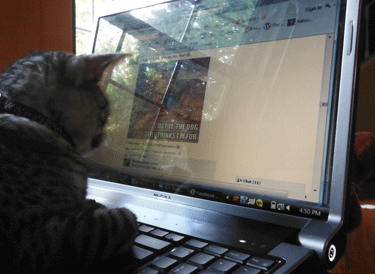
Who needs opposable thumbs when all you need to write is "zzzzzzzzzzzzz"?

Who needs opposable thumbs when all you need to write is “zzzzzzzzzzzzz”?

At first, it’s merely annoying. He sits upright, staring at the computer screen while I work, pretending he knows how to read. Craning to see around his giant radar-dish ears, I type with my elbows out so he has plenty of space. If I let down my guard and actually TOUCH him, I trigger the “game on” alert and he goes into overdrive. Engine on motorboat purr, he offers his chin for a rub (aaahhh, more please) and then starts searching about for something to bat, nip, or climb. Of course, the only thing to climb is me, which is fine by him.

He works is way up to my shoulders and stops for a snooze—his front half draped over my back like a Salvador Dali clock; his butt is just about level with my nose. This somewhat hampers my ability to type and tends to stifle creativity.

Oh, I know what you’re thinking. And yes, he has a bed. Right in the window. A FOOT away. A soft piece of art that serves no functional purpose. Should I be so bold as to actually set him there, he immediately leaps onto the desk and disappears down behind my laptop into a cluttered, cat-sized space that is lined with sticky notes.

Cat behind the scene

If you need anything, I’m right here. Hey, do you need anything?

Every few minutes, his big ol’ head rises up behind the screen like a corny mechanical road sign and he lets me know he’s still there.

I really shouldn’t complain. After all, I am working from home, and to his credit, he did give me a blog topic today. I suppose he can stay. Eventually though, we’re going to have to come to an understanding. Either he starts contributing to the word count or the Mousie gets it.
A Charleston Portrait

4 Feb

To celebrate our 30th anniversary (and to mark my leap from steady paycheck to struggling writer status), my husband and I spent last week in the Lowcountry of South Carolina. We chose Charleston because we wanted to go somewhere we’d never been, that was near enough to drive to but far enough away that we could escape the cold Virginia winter.

Naturally, we spent three of our five days practically snowed in.

“First storm like this we’ve had this decade,” said all the locals.

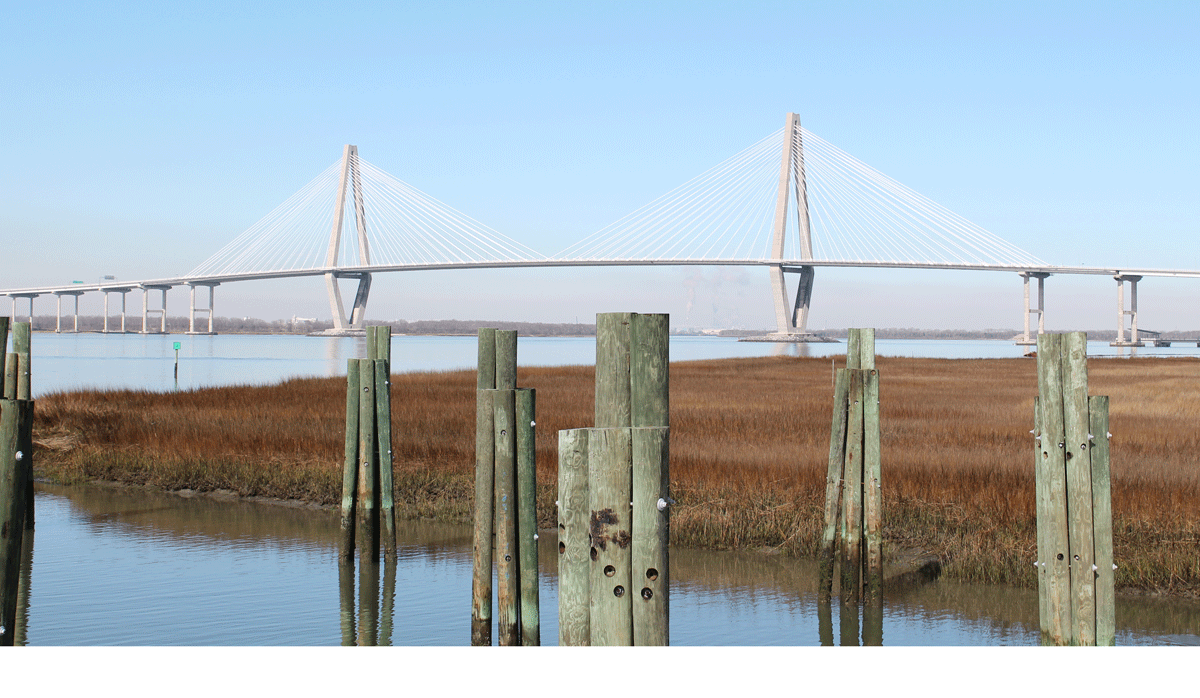
Ravenel Bridge

Beautiful, but quite useless in a snowstorm, Ravenel Bridge

It wasn’t much by Virginia standards, but it was enough to shut down the city. Even the elegant Ravenel Bridge, the main route to the downtown area, was closed throughout most of our visit. It was opened briefly when temperatures warmed, but quickly closed again when ice falling from the rigging began crashing onto crossing vehicles, apparently annoying drivers in them.

Because we were staying at Mount Pleasant, this meant either taking the alternate route with hundreds of cranky re-routed commuters or staying on the island and seeing the sights there.Initially, I was quite disappointed. I wanted to experience the Charleston I’d been hearing about for so many years, its lovely markets and restaurants, and that legendary Southern charm.

We instead went out to Isle of Palms, and explored Fort Moultrie on Sullivan’s Island. It was all quite nice, but cold, and I’d hardly say charming.

Then we met Mazie Brown, a sweetgrass basket weaver with a small stand on Highway 17. Sweetgrass weaving, South Carolina’s official handcraft, is an art only found in this region, and the baskets are sold only in the downtown markets and along this highway. Mazie was one of only a few weavers brave enough to set up shop that day, when cold was warding off potential customers.

From the moment we entered her tiny hut we were charmed. Mazie flashed us a wide and welcoming grin, and commenced to chatting as if we were old friends.

“You’re lucky you come by when you did,” she said. “Soon the only place you’ll see baskets like this is in the museums.”

Mazie talked about her art, which she’d been practicing since she was 6, and this stand, which her Mama had established 29 years ago and which Mazie had taken over after retiring from her nursing career. While I listened, I pulled down some of her creations, running my fingers along the intricate patterns woven from grasses and palms.

“Those dark parts is pine and bullrush,” she said, pride emanating from her deep brown eyes. “And that’s palmetto, holdin’ it all together.”

Her weathered hands stayed busy, braiding a stalk of sweetgrass into a circle, the way her Mama had taught her: in the Gullah tradition maintained more than 300 years by Africans brought to America in slavery.

“It’s dyin’ though,” she said. “My children want nothin’ to do with it. They don’t have the patience…rather play on their textin’ machines.”

My husband held up a serving platter that she said took about two and a half days of weaving to complete. What a shame this art might disappear. We’ve since learned that not only is the coming generation losing interest, but regional development is depleting the sweetgrass supply. Access to the grasslands is limited; harvesters travel nearly 90 miles to find grass, or they buy it like Mazie does.

“When I was a girl, I used to go with my Daddy to pull it up,” she said. “Wouldn’t do that today. There’s so many snakes in the grasses now.”

We purchased the platter and asked her to sign the back. Her face lit up afresh and she pulled a sharpie of her pocket; our request wasn’t original.

“Some folks don’t want ‘em signed, but I’m always happy to do it,” she said.

As she carefully spelled out her name on the evenly spaced palmetto coils, Mazie continued to talk about her family, being alone despite two marriages, surviving cancer seven years now, and about her love for the weaving craft. We could have listened for hours; she had such a sweet storytelling gift.

Mazie Brown

Mazie Brown, artist and storyteller, Charleston personified

So enchanted was I by Miss Mazie, I did something I rarely do, as anyone who knows me will attest. I wanted to have my picture taken with her. I could tell when I asked that she shared my loathing for the camera, but she obliged (albeit, never looking into the lens). Jerry and I both felt compelled to hug her goodbye.

We eventually got to the city, to a few good restaurants (shout out to Page’s Okra Grill!) and to the market where baskets similar to Maize’s were triple the price and stalls were just business establishments. After Mazie, it was a bit anticlimactic.

I’m not sure we would have met Maize if not for the weather; I’m so glad we did. To me, she is now family. To me, she is Charleston. And a lovely, charming place it is.

Leaping into the Light

12 Jan

I believe this earth is just one big battlefield for good and evil.

I believe that every one of us, whether we want to be or not, is part of the battle, and that during our short time on this earth we each do three very important things:

  • Chose a side
  • Find our role in the war
  • Help equip others to do the same

All roles in warfare are vital. We need soldiers on the front lines to shield us from the fire, factory workers to produce equipment, scientists to develop tactics and technology, doctors and nurses to keep us in fighting shape, listeners to keep us sane, and teachers; oh boy, do we need good teachers to prepare our children for the fight ahead and teach them to seek truth.

For the past 12 years, I’ve been an editor with an Intelligence organization. I serve with a fine group of warriors who stand at the edge of darkness, peering into the vast unknown for signs of the enemy. After they’ve sifted through evidence, trends, and potential implications, I help them articulate their findings effectively. It’s a good job. I’ve learned a lot about the world, made many friends, and enjoyed a steady paycheck. If I stick with it three more years, I’ll qualify for some good benefits for my retirement years.

Two years ago, I participated in a leadership training course that included an exercise designed to help us identify our strengths and passions and figure out what to do with them. After culling through a lengthy list of phrases beginning with the words, “I most like to ____,” we each created lists of 40 possibilities, then culled that to 20, then 10, then 4, then circled the one that we thought best captured who we are. We posted our discoveries on the walls around us, and I read with awe the passions of my coworkers:

  • “I most like leading a team.”
  • “I most like solving difficult problems.”
  • “I most like to collaborate on tough assignments.”

These were some focused individuals; I could see the Intelligence field was a perfect fit for them.

I, on the other hand, culled my list down to, “I most like to create art and beauty.” Hardly a warrior’s creedo.

Over the past two years since that course, I’ve been mulling my discovery; there’s no place on the battlefield for art and beauty, I thought. But lately, I’m not so sure. Perhaps that’s exactly what the world needs more of. Still, I cannot shake the notion that, although I am good at what I do in the Intelligence arena, I don’t belong there. My battle is elsewhere.

Where there is light, there can be no darkness

Where there is light, there can be no darkness

My role, I think, is to fight evil with light; to help those who may know which side to fight for, but have yet to make a formal pledge. I think I’m also supposed to encourage those who are fighting in the darkest corners and who think evil might be gaining the advantage. We can’t lose, of course, because the battle has already been won, but sometimes it can feel like we’re losing.Where there is light, there is hope. When I pick up a pen, light emerges through art and beauty.

That is why I made my decision; I’ve given notice at my work that as of January 24, I will no longer be an editor serving the U.S. government. On that day I will become an ordinary writer, serving in the Army of God. The pay will be horrible, particularly at the start, but I know the Lord will provide for our needs.

My first order of business, of course, will be to finish writing Joe’s story. He’s been more than a little patient with me since last summer, and I hope he will find the story worth the wait.

After that? Who knows? The Portrait Writer will be open for business; after that, anything can happen.

“The light shines in the darkness,
and the darkness has not overcome it.”
  1 John 1:5

The Early Bird Knows the Secret

4 Jan

I awoke to four sweet, staccato chirps, and smiled as I listened to the persistent warbler outside my bedroom window. Again and again he beckoned to me with the same four-note aria, paying no heed to the drawn shade that separated us. I knew he was calling to me, but I didn’t want to stir from my warm bed. Tossled, twitching branches on the tree outside cast a quivery shadow against the shade, and a blustering gust of wind buffeted the house’s siding, confirming my suspicions: It was a cold, windy day out there.

I think I’ll stay put, thank you very much.

Still he sang. His notes were melodious and clear; I was content to just lie there and listen. So much joy from such a tiny creature! I couldn’t imagine what this bird might have to be joyful about. Surely if he knew the snug coziness of an electric blanket he might be singing a different tune out there on that naked tree limb.

Eventually though, his song (and the thought of a hot cup of coffee) got to me. I extricated my lazy self from the soft covers, covered my flannel jams with my warmest robe, and crossed over to raise the shade, mentally prepared for a bleak January scene.

How wrong I was.

Instead of bleakness, the world outside had transformed overnight into a pristine wonderland. Two inches of pure white blanketed everything around me, and a rather spectacular sunrise was radiating its golden orange light across the snow-covered trees and rooftops, glistening majestically as far as I could see.

And there was my soloist: a tiny brown wren with his beak pointed up to heaven, singing for all he was worth. How could he not? He cocked his head to look at me, as if to say, “See? Didn’t I tell you?” and resumed his joyful twittering.

I watched for quite some time, mesmerized. All too soon, the golden hue dissipated as the sun rose higher; leaving a scene that was still beautiful, but slightly less enchanting.

To think I would have missed that just to stay comfortable.

Then I went downstairs, where the morning had more delight in store for me. Entering the kitchen, I noticed a particularly large shadow cross the window as something flew to the birdhouse in the back yard.

Probably those darned crows, I muttered to myself. Such bullies they are.

I headed over to the sliding-glass door to thump the window pane (like that ever works). To my amazement, it wasn’t crows, but the return of our favorite winter visitors, the Pileated Woodpeckers.

Pileated Woodpecker

This is Dactyl. Don’t be fooled; that’s a relatively small birdhouse he’s perched upon.

Now, these guys aren’t your average woodpeckers. In fact, we’ve named them Terry and Dactyl, if that tells you anything. They are so large, even the crows give them wide berth. According to our bird manual, the Pileated Woodpecker can grow to about 17-inches long. They also have a deep red crest. I could watch one for hours.

The thing is, they never stick around long, and they’re early risers so we don’t catch a glimpse of them often. If I’d stayed in bed, I would have missed this as well.

How many of us live our lives like that? Chosing comfortable, safe, and familiar over the unknown, wondering what’s “out there” but not curious or brave enough to go look for ourselves? What do you suppose we’re missing?

At my office, I work with quite a few brilliant people who sit in their familiar cubicles day after day performing mundane tasks, all the while saying there must be a better way and purposefully ignoring the “I wonder ifs” hovering overhead:

  • I wonder if I could make it as a professional photographer.
  • I wonder what it would take to start my own brewery.
  • I wonder if I’ll ever go to law school.
  • I wonder if I should homeschool my child.

I know this, because they do occasionally talk about their dreams, and because I do the same thing. For the past ten years, I’ve been talking about leaving my job to write full-time, but the office paycheck is steady and my coworkers are great people. It’s comfortable.

But change is waiting for me, like the wren outside my window, singing, beckoning.

The time has come to throw off the cozy blankets. Can I do it this time?

…I’ll let you know next Saturday.

Nobody’s Squashing My Christmas!

5 Dec

Why do people go out of their way trying to squash Christmas? Is it a coincidence that the people who want to douse our joy tend to be angry when they do it? What do you suppose is the source of their unhappiness? Could it be our happiness? Here are just some of the things I’ve already heard, in just the first week of December:

  • “Decorating a tree is a pagan custom, and even Jeremiah 10 says Christmas trees are evil.”
  • “Christ wasn’t born on Dec 25. He wasn’t even born in December! How foolish can you be?”
  • “Gifts only take the emphasis off Christ by making people anticipate what they’re getting.”
  • “We shouldn’t lie to children about Santa. That sets them up for disappointment.”

If these are your views, you are welcome to them. In my house, there’s a party going on. My heart nearly bursts with joy every year as I prepare my home for the season. It’s a happiness I’m not willing to give up to appease some angry people.

Jesus My Savior

Peace on Earth


Those verses people cite in Jeremiah to stomp on our tree tradition, in context, describe the futility of chopping down a tree to whittle an idol, such as the golden calf, which is painted gold or silver, nailed in place, and then worshiped. Jeremiah says they are only wood, and cannot speak, move, do good or do harm.

In my home, we have not made our tree an idol. We do not bow at the tree, because it is only a decoration—one of many we use to transform our ordinary rooms into a tangible expression of the joy in our hearts. We also have candles, ribbons, bells, and snowmen. It’s ABSOLUTELY BEAUTIFUL! None of these are the center of our attention. In fact, we don’t bow down to worship the manger scene either, although it has a place of honor in our home throughout the season—and yes, we put the baby in the manger on Day One.

Nobody knows what date Christ was born. Sure, it was likely late fall, or maybe even earlier. We don’t care about that. I have a friend who was adopted from another country and doesn’t really know his birth date for certain, because clear records were not kept. Guess what? He celebrates anyway. December 25th was chosen (and I don’t care what pagan influence went into the decision, I really don’t) to celebrate the birth of Christ, and so I celebrate.And gifts? They’ve never been the reason for our season, but we all love to give them. If you ask my boys what they want for Christmas, they will shrug and give some vague answer, because they honestly haven’t given it much thought. They were raised not to expect or ask for gifts. Instead, we make a big deal of giving—providing for those in need by participating in community outreach efforts, presenting small gifts to our friends and neighbors to say we appreciate them, and keeping secrets from one another in anticipation of the smiles we will see on Christmas morning. There’s no rummaging through each other’s closets—that would crush someone’s joy. We give because Jesus gave, although our gifts pale in comparison to everlasting life.

As for Santa, I think my oldest explained it best when he sat me down (I think he was about 9 or so) to tell me he’d figured it out. “Santa is all of us,” he said. “It’s us being good to each other.”

What joy I felt when he said that. It stays with me today, nearly 20 years later. My youngest, who is 14 now, is excited about giving, and has already sent me a link for “the perfect gift for Dad,” for which he will willingly sacrifice a few weeks of allowance. Santa is not a lie; he’s an ideal. He may have been created through myths; he may have been the Dutch Bishop Sinterclaas, known in the United States as Saint Nicholas; or he may have been a wild maniac pulled from the closet of some paranoid pagan dwarf. All that matters is that, in my family, today, he represents love. I AM Santa, and so are you.

I close this writing with perhaps the saddest Christmas misconception I know of, most often expressed by the phrase, “Peace on Earth! What a load of garbage. There is no peace here.”

To that I must say, oh, yes there is. When Luke wrote of the angels visiting the shepherds in the fields on the night Christ was born, he did not record them saying the entire world will be at peace; instead they said, “Glory to God in the highest, and on earth peace to men on whom his favor rests.” This means, now that Christ has come to us as one who glorifies God, we never need to worry about what’s happening on earth because we’re here temporarily and there’s a lot more to come when we move on. If you love the Lord, and welcome him into your life, you can find peace—even in the darkest times. And nobody can squash that.

So tell your nay-sayers to take a hike, but pray joy will open their hearts. Perhaps one day they’ll get it: If God knows our hearts, He can see our joy. We needn’t be hesitant to anticipate, decorate, or celebrate as we rejoice and praise God for sending His son to us.

Have a Merry, Merry Christmas.

Taking Joy from the Trees of the Field

13 Nov

Last night’s howling winds have abated, leaving a bleak urban skyline outside my window where only last week a magnificent canvas of fiery color took my breath away. Today, as I look in most directions, I see mainly outstretched limbs of naked trees.

Full tree of red and orange

The Trees of the Field Will Clap Their Hands

But right next door, and at the end of the street, and on street corners throughout the neighborhood, are trees (mostly maples, I think) still round and full, bursting with glorious color. I don’t believe the tree next door has relinquished a single leaf. It gives me great joy to witness such life, even as parts of it are dying.

People are like that, aren’t we? We’ve all had our leaves change color and darken. We’ve lost loved ones, said good-bye to childhood friends, felt that gut-wrenching blow of bad news from which we’re not sure we can ever recover. Some of us lay down our leaves as soon as we see their loss as inevitable. Others shine forth, seeing each day as a gift and each step in the struggle as part of a worth-while journey.

My life has been blessed by full trees—people who shine regardless of their situations.I see it in my friends Michele and Sheryl, whose lives are being buffeted by headwinds of heartache and change. I picture them, leaning forward against the gusts, sliding one determined foot just barely ahead of the other as they inch their way across the wet, slippery road. Still, they stand. And if you stand near them, they will put an arm across your shoulders or fold you into a hug so personal that you feel refreshed and strengthened for another day.

I see it in Doug and Matt, whose roots went without water for many seasons, until their eyes became dull and listless and they despaired of becoming lost in the darkness. Then they found their way back to the well and drank deeply, and today they radiate so much joy that all those around them can’t help but smile with them and lean in to listen when they speak. They give me hope for the future of this nation.

I see it in my neighbor Bill and in my friend Craig, giant oaks whose roots (or those of the trees around them) are being blighted by cancerous invaders. They don’t know if treatments will drive out the disease, but they sing anyway, and find reasons every day to be grateful. Their faces shine, and they speak light into the darkness.

These full trees have much in common. They each bear scars from harsh weather and lightning burns, and some of their limbs have been pruned, yet they are taller and stronger than they have ever been, and we who watch can only be inspired by their color. Most importantly, they emit hope. They know that brown leaves do not signify the end, because they’ve seen this before. This season will give way to a new one that is lush and green, and there will be fruit again. They know that God has promised to bring them through this, even if they don’t know where “through” will lead. We’ve learned from Shadrach and company that even if God does not bring us where we want to go, we can trust that what He’s doing is for our good.

This does not mean we cannot grieve or feel sadness as the leaves are stripped away, but that, as the season ends, we remember a new season is coming. Being unsure of our future does not mean we must be afraid.

As we go through trial, each of us must choose whether to display despair or hope. I’ve peeked at the end of the story, and I know it’s full of hope. I want my tree to be full until every last leaf falls to the ground and they come haul me away to be used for firewood—and even then I’m gonna make sparks fly!

Job 19:25-27   I know that my Redeemer lives, and that in the end he will stand upon the earth. And after my skin has been destroyed, yet in my flesh I will see God; I myself will see him with my own eyes…”

Fire and Water: Wrestling with Doubt #739

30 Oct

The fire crackled with life as it swept its way across a stack of manuscripts, greedily consuming page after page. Through tears I watched the pristine white papers transform into thin, black feathery curls that peeled off, danced momentarily with the updraft and then drifted resignedly down into the ashes.

Fire consumes a life's work

Death of a Dream

I thought I might be able to rescue a scrap or two by pushing some of the charred lumps to the side of the fireplace, but my mother must have read my mind. She grabbed the metal poker and stabbed at the carbon-coated mass to separate the blackened pages; she was determined to destroy every remnant. I could smell the words in the stench of burnt ink that wafted around me. I was 14, and newly enamored with the life and writings of Laura Ingalls Wilder. This was my first experience with death.

“Writing is a waste of time,” she spat, her breath so laden with alcohol I worried the fire might flare if she got too close. Her eyes were bloodshot and her hair was matted against her head with the sweat from days of neglect. She pointed the poker at my chest and slurred, “Don’t you dare tell me you want to be a writer.  It’s a pointless dream that will amount to nothing, and 40 years from now you’ll be a sorry loser, wishing you’d never started.”

She flung the poker wildly, just missing my head, and staggered from the room. I stayed there for hours, sobbing and staring at the black pit long after the fire died, trying to come to grips with the idea that every word, every sentence, and every page of every story my mother had ever written, was gone forever.

Today, nearly 40 years later, I am profoundly aware of the significance that moment has had in my journey. Somewhere in my heart, I believed her. I’ve spent the past 40 years skipping along the edge of the sea, yearning. Occasionally I’ve ventured ankle-deep, savoring the warmth and trying to imagine what’s “out there.” But I’ve never leapt with abandon. People ask me what I’m afraid of, and I remember the charred remains of dreams and the scent of unread words. It is my image of hopelessness.

That was the image in my heart this morning after I missed yet another self-imposed writing goal. I could hear my mother mocking me, reminding me that I have no business dreaming when there’s work to be done. Another failure. Who am I fooling?

But I cannot quell that constant, gentle song of unwritten words that calls to me above the din of the world’s demands. As is my habit, rather than follow the call, I tend to lash myself to the Siren of perceived obligation that is my “real job.” How did things get so backward?

Then this morning I read a familiar verse in the book of Jeremiah (29:11), and it spoke to me anew:
“For I know the plans I have for you,” declares the Lord, “plans to prosper you and not to harm you, plans to give you hope and a future.”

I’m reminded that I can start again and again, as often as I wish to, because I have hope and a future. There’s a whole big ocean of possibility out there and I’ve not even dared to snorkel across the top. The only thing stopping me is me. I can choose whether to listen to voices past or the voice of the future. It’s not a waste of time. It’s His plan.

And He says, “C’mon in, the water is fine!”

 —–

“Decide that you want it more than you are afraid of it” Bill Cosby

Love means ALWAYS having to say you’re sorry

9 Oct

“Oh Lord,” I say, “I know you’re on my side here. Why is he being so stubborn? I really miss his friendship.”

Then tell him that, and say you’re sorry.

“But I have nothing to be sorry for. He started it. He never apologizes. If I apologize, I’m saying it’s ok for him to keep doing this.”

So, you think that by staying angry, you’re going to make him sorry? Isn’t that somewhat manipulative?

“Well, when you put it like that, maybe. But I don’t know what else to do. I just want him to acknowledge that he hurt me.”

Then write him a letter. Say you’re sorry.

“For what?”

You’ll think of something.

I stare at the paper, too angry to write. I won’t be a hypocrite.
But I can picture Jesus, one eyebrow raised as He waits.

“Fine. I’ll do it. But just to get you to stop nagging.”

I grab my pen and scrawl, “Dear Friend, I’m sorry you’re so stubborn…”

Hey now! That’s not the way I taught you.

“At least it would wake him up. I’ve got nothing else.”

Nothing? Well for starters, you could apologize for trying to be me.

What do you mean?

Last time I checked, it was my job to change people.

My sarcasm gets the best of me, and before I know it, I sputter out an ace of a retort.

“Well, Lord, I don’t see you changing anyone.”

Haven’t I though? What are you thinking right now?

I refuse to answer. Instead, I fold my arms across my chest. I really hate it when He’s smug.

Come on, He coaxes. You know you want to.

He’s referring to a quote by some anonymous author that I have pasted on my FaceBook page. It makes me smile. He used my own words against me.

“I can’t believe you went there,” I say.

Nevertheless, it’s a favorite, so the words just flow through my mind…

“God grant me the serenity
to accept those I cannot change,
the courage to change the one I can,
and the wisdom to know it’s me.”

He grins, and points back to the paper.

I know He’s right. I know it’s the only way. There’s only one part of my life I can control—my own actions.

I pick up my pen and start again.

“Dear friend, I’m sorry I treated you so badly. I love you and I miss our friendship.”

Just writing the words, I feel release.

Portrait of a Real American

2 Oct
Columbus Abbit Frank

Columbus Abbit Frank

Today I have the honor and privilege of introducing you to Columbus Abbit Frank, a U.S. Marine veteran who fought in the battle of Iwo Jima during World War II.
Our family has known Frank for many years (he’s my husband’s uncle―who, incidentally, has been known only as “Frank” since he attended boot camp in 1944), but we never took the time to learn his story. All we knew about him was that he had fought at Iwo Jima.
In the 90s, Frank and his wife, Loretta, came to visit us in Northern Virginia, and we took them to a Sunset Parade at the Marine Corps War Memorial in Arlington (an amazing demonstration that I’d encourage every American to experience at least once).
Because of Frank’s service at Iwo Jima, he was seated in the hosting general’s section. Frank, then in his late-70s, wore the requisite veterans’ Iwo Jima ball cap as he walked past the gauntlet of civilians and Marines toward his seat. Every Marine who noticed the cap snapped to attention and saluted, adding either “Oorah, Sir,” or “Semper Fi, Marine,” or even just, “Thank you, Sir.” I’ve never seen a man treated more honorably, and was more proud of the Marine Corps at that moment than I’ve ever been, before or since. By the end of the night, Frank’s face was beaming, and his pride was evident.
Still, we didn’t ask for the entire story.
Nearly 20 years later, we visited the monument again, this time with our youngest. We told him about the battle, and that his great uncle had fought there, but we had no details to add. It was an awakening of sorts. We realized with regret that we’d been taking for granted the living history available to us just for the asking.
So, we set out to capture his story for the family archives, and got much more than we’d expected. Not only is this an incredible war story, but it also tells of a strong, hard-working man who refused to be kept down by the hand originally dealt him, and who made his own way in the world despite the challenges of his childhood. He is the epitome of Real America, where a person can advance as far as he can dream, if he’s willing to work for it.
Better yet, Frank has not only allowed me to tell his story, but also to hang it on my Portrait Page so we can share it with you. I hope you’re as inspired as we are by this ordinary man with an extraordinary story.

NOTE: Special thanks to Charles, my 14-year-old, who conducted the interview on a recent trip to Sacramento, and to his dad for getting him there.

God Bless you, Uncle Frank, and thank you for your service.

Sweet Summer Sunday

16 Sep

My brain has been dulled by a frantic search for unwritten words; I’ve been fooled by the calendar and its desire to propel me forward toward self-imposed deadlines. The leap-frog days of July and August have ushered summer off the stage, because that’s what days do. They usher in busyness.
On cue, school buses rev their engines, football stadiums open their doors, and mulch flyers find their way to our doorsteps. Candy corn is back on the store shelves. The woodpile has been stocked. It must be autumn.

Butterfly in the garden

Sweet sip of summer

But apparently, Nature does not use a calendar. Nor does Nature rush. So, this afternoon, when I could have been writing, I instead found myself lying on a park bench by the pond—eyes closed, pen lost—letting the sun bake my to-do list as if it were a bonfire marshmallow. I savored the rustling of the lush green trees, which showed no sign of changing color, and the gentle clucking of the ducks and geese, who seemed in no hurry to leave. I breathed in a summer bouquet: grilled steaks, roses in bloom, and freshly mowed grass. For the first time in months, I just rested. It took valiant resolve to rouse myself at sunset and head home.
Tonight I lie awake, listening to the symphony outside my open window as crickets and toads toast the glorious moon. I’m pulled from my bed, enticed by their joy. Telling myself I’m going to regret this in the morning, I quietly slip outside to listen to the concert and stare at the stars. There’s a soft rustling in the trees as they sway—perhaps we’re listening to the same song. Nope, I won’t regret this.
It has been a lovely day. A lovely, summer day. And in this peace, in the quiet of God’s amazing display of beauty and perfection, at last, the words come.